
Disposal of sewage sludge (WWS) without sludge lagoons by processing into marketable products
Disposal of wastewater sludge (WWS) without sludge beds by processing into marketable products
Current status of WWS disposal
Main directions of WWS disposal:
1. Burial on sludge beds.
2. WWS
recycling as fertilizer.
3. Direct combustion method.
4. Pyrolysis recycling method .
1. Deposition on the sludge beds.
At present sludge beds process 90% of the total sludge produced in
2. WWS recycling as fertilizer.
WWS recycling is limited by two factors: sanitary-epidemiological and sanitary chemical. Modern technologies eliminate the epidemiological risk.
However, toxic components contained in sediments (Cd, Cu, Ni, Pb, Cr, Zn, Hg, As, Mn, and in some cases, Mo, Se, Co, Sr, B, Be, Ba) that exceed background levels in the natural objects obstruct their recycling in agriculture and impede the use of such sludge as ‘recultivants’ of disturbed lands. To prevent environmental pollution by heavy metals (HM) the majority of countries have established national standards for maximum permissible content of heavy metals and WWS to be recycled.
Nevertheless, in Western Europe many farms which grow environmentally-friendly fertilizer products reject them.
3. Disposal by direct combustion.
The WWS direct combustion method includes combustion in a boiling (pseudoliquified) layer implemented by BAMAG GmbH (a company from
The boiling layer technology enables to burn the material in a flare of hot sand raised by an air stream; slag with harmful oxides which are to be subjected to a multistage treatment goes away with the exit gases.
Such plants were massively built in
It shall be noted that in recent years many industrial waste combustion plants (including wastewater treatment combustion plants) have been closed in Europe and
European countries are gradually withdrawing from WWS direct combustion method and switch to WWS treatment methods which enable to get marketable products and at the same time minimize operating costs.
4 . Recycling by pyrolysis.
The most progressive method. During pyrolysis (oxygen-free thermal decomposition of organic substances) at a temperature not higher than 700 °C, one obtains a combustible gas ( ~ 55 %) , char (~ 35 %) , liquid organic materials ( ~ 15 %), which fly away with exit gases at these temperatures and char is subjected to semi- gasification process and also turns into a combustible gas.
The metal oxides remain in the gasification chamber in the form of pure slag suitable for use as a mineral filler.
WWS only I subject to gasification and pyrolysis of organic constituents , so emissions do not contain harmful substances , as in the direct combustion method. Table 1 shows the composition of WWS-based combustible gas indicating the absence of harmful components.

Pure slag

Char

Dry remains
Таблица 1

Purpose of the project:
1. Recycling of sewage sludge by pyrolysis and gasification with a fuel gas for the production of power and heat used for the process.
2. Environmentally-friendly disposal of sludge beds without any harmful emissions.
3. Obtaining of marketable products as generated power and paving slabs (optionally).
Description of the main stages of technology
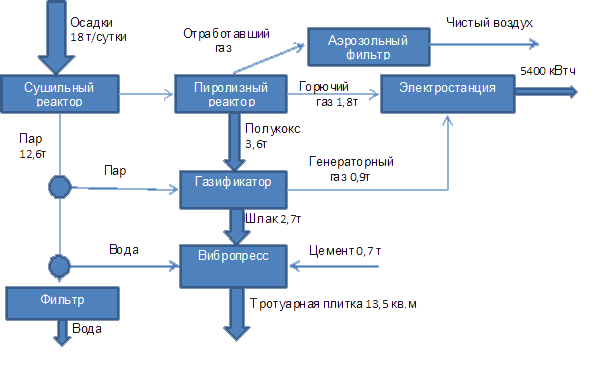
1. Sludge drying (70% humidity) up to 5% or less.
2. Oxygen-free pyrolysis.
3. Gasification of char.
Burning of generated gases in a gas reciprocating power plant for power production
Two options to use slag:
Option A: Mixing slag with cement, vibration pressing to produce 100mm paving slabs of different configuration and color
Option B: Removal of slag for use in road construction works, filling dumps, etc.
UNIT INSTALLATION DIAGRAM
Baseline: performance of dewatered sludge 18 t per day / 70% humidity.
BASIC COST/PERFORMANCE RATIO
PRODUCTION CAPACITY :
Dewatered sludge , t / year .................................................. 6570
Power kWh / year .................................... 1971000
Paving slabs, sq.m / year ................................................. 4930
PRODUCTION AREA, sq.m ........................................ 100
Number of workers, persons ....... 10 (including the production of paving slabs)
8 (without paving slabs)
Installation costs ................................................. 9.7 mln
(without paving slabs ) 8.7
MANUFACTURING DATE, months . 4.0 ................................................................
Payback period 2.5 ....................................................................
SERVICE LIFE, 15 years ..............................................................................
March 2009